COMPETITIONS
TSA competitions provide an opportunity for students to take learning beyond the classroom and explore topics of career interest. TSA provides rules and guidelines, that can be integrated into your STEM curriculum, for more than 75 middle school and high school competitions.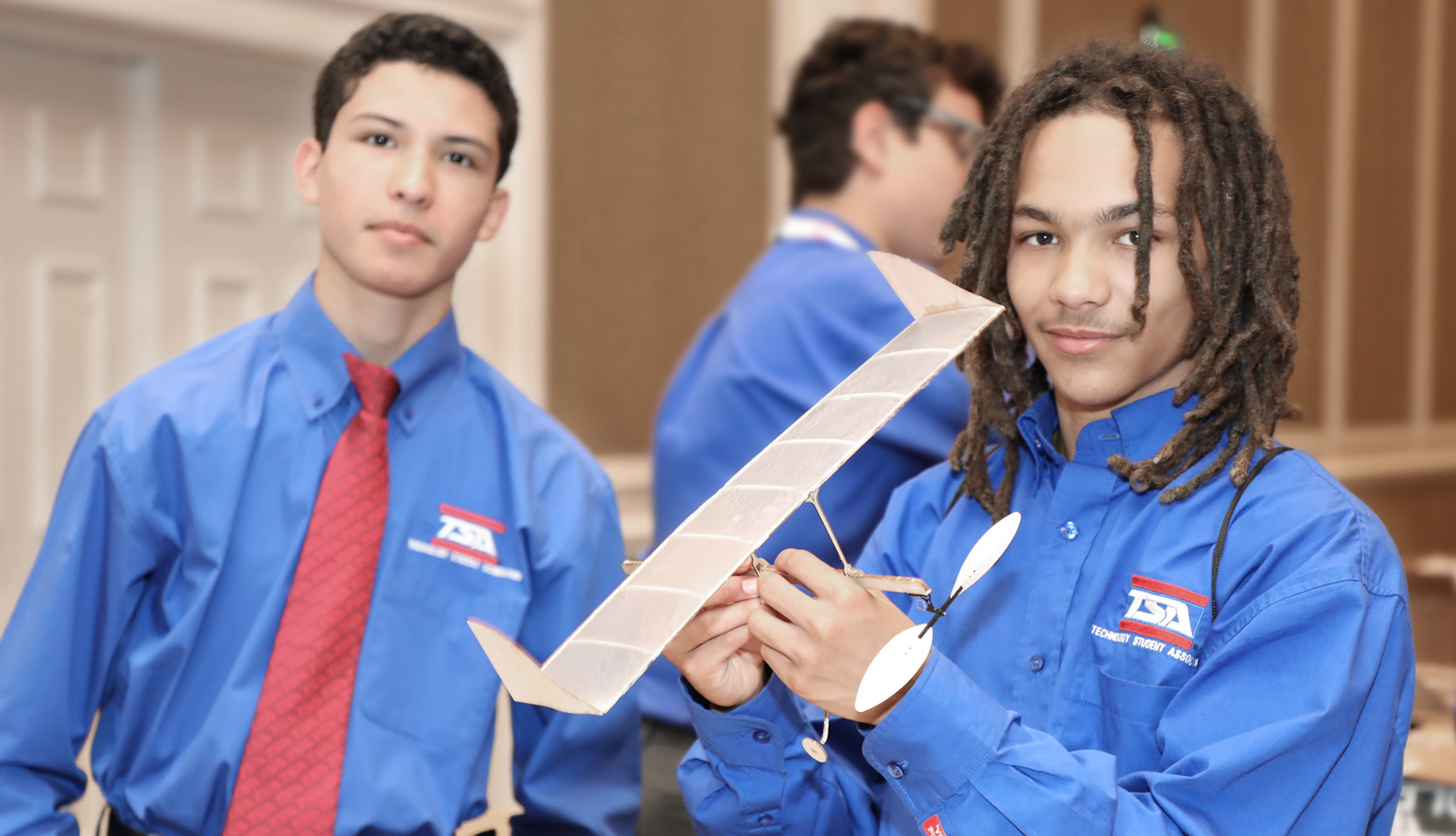

TSA offers 36 middle school competitions. Click on a category below to view a list of TSA middle school competitions and their summary descriptions in that category.
Website Design
To address the annual challenge, participants design, build, provide documentation for, and launch a website that incorporates the elements of website design, graphic layout, and proper coding techniques. Semifinalists participate in an interview to demonstrate the knowledge and expertise gained during the development of the website.

TSA offers 36 middle school competitions. Click on a category below to view a list of TSA middle school competitions and their summary descriptions in that category.
Technology Problem Solving
Participants use problem-solving skills to design and construct a finite solution to a challenge provided onsite at the conference. Solutions are evaluated at the end of 90 minutes using measures appropriate to the challenge, such as elapsed time, horizontal or vertical distance, and/or strength.
Transportation Modeling
Participants research, design, and produce a scale model of a vehicle that complies with the annual design problem. A display for the model and a documentation portfolio – containing elements such as a description of the vehicle, photographs and commentary detailing the vehicle production, and technical illustrations – are required. Semifinalists participate in an interview.
Video Game Design
Participants design, build, and launch an E-rated online video game – with accompanying required documentation - that addresses the annual theme. Semifinalists participate in an interview to demonstrate the knowledge and expertise they gained during the development of the game.
Virtual Reality Simulation (VR)
Participants use video and 3D computer graphics tools and design processes to create a two-to-three-minute VR visualization (accompanied by supporting documentation) that addresses the annual theme. Semifinalists deliver a presentation about their visualization and participate in an interview.
Vlogging
Vlogging encourages good storytelling, videography, and editing techniques to create a coherent series of creative work. Applying leadership and 21st century skills, participants use digital video technology to create original content that reflects an annual technology theme. Semifinalists complete an onsite challenge to produce additional video(s). Required criteria, such as props, lines of dialog, topics, etc., will be revealed at the semifinalist orientation meeting.
Webmaster
Participants design, build, and launch a website that addresses the annual challenge. Semifinalists participate in an interview to demonstrate the knowledge and expertise gained during the development of the website.