COMPETITIONS
TSA competitions provide an opportunity for students to take learning beyond the classroom and explore topics of career interest. TSA provides rules and guidelines, that can be integrated into your STEM curriculum, for more than 75 middle school and high school competitions.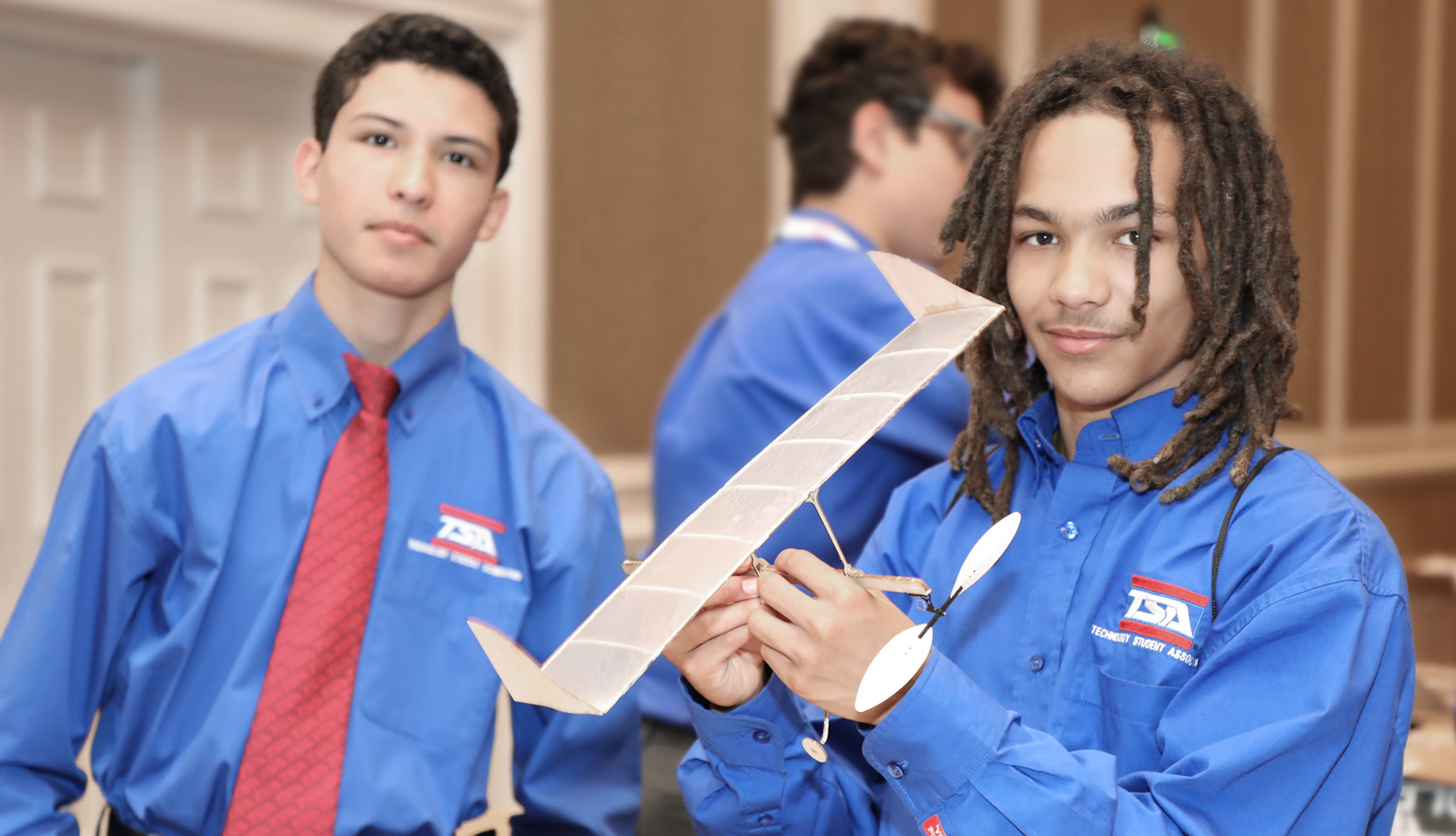

TSA offers 36 middle school competitions. Click on a category below to view a list of TSA middle school competitions and their summary descriptions in that category.
Audio Podcasting
Participants use digital audio technology to create original content for a podcast piece that addresses the annual theme. The podcast must feature high level storytelling techniques, voice acting, and folly sound effects. The full entry must include documentation of the podcast development process and elements. Semifinalists complete an onsite challenge to produce an additional podcast(s).
Challenging Technology Issues
Following the onsite random selection of a technology topic from a group of pre-conference posted topics, participants work to prepare for and deliver a debate-style presentation, in which they explain opposing views of the selected topic.
Children’s Stories
Participants create an illustrated children’s story based on the annual theme. The entry product is a physical storybook of artistic, instructional, and social value. Semifinalists read their story aloud and participate in an interview.
Prepared Speech
Participants deliver a timed speech that relates to the theme of the current national TSA conference. Semifinalists and finalists are determined using the same competition procedure.
Promotional Marketing
Participants create and submit a marketing portfolio and required elements that address the annual theme/problem. Semifinalists complete a layout and design assignment for evaluation.
TSA offers 36 middle school competitions. Click on a category below to view a list of TSA middle school competitions and their summary descriptions in that category.
Animatronics
To address the annual design challenge, participants exhibit and demonstrate their knowledge of mechanical and control systems by creating an animatronic device with a specific purpose (i.e., communicate an idea, entertain, demonstrate a concept, etc.) that includes sound, lights, and an appropriate surrounding environment (a display).
Architectural Design
In response to the annual design challenge, participants develop a set of architectural plans and related materials, and construct both a physical and computer-generated model and virtual walkthrough to accurately depict their design. Semifinalists deliver a presentation and participate in an interview.
Artificial Intelligence
Applying leadership and 21st century skills, participants demonstrate knowledge of artificial intelligence (AI) concepts, models, and best practices by completing a test to qualify for semifinals. Semifinalist teams solve an onsite problem(s) using a generative artificial intelligence (GenAI) tool. Completed solutions are objectively measured to determine the best solution for the stated problem.
Audio Podcasting
Participants use digital audio technology to create original content for a podcast piece that addresses the annual theme. The podcast must feature high level storytelling techniques, voice acting, and folly sound effects; the full entry must include documentation of the podcast development process and elements. Semifinalists participate in an interview.
Automated Manufacturing Systems
Applying leadership and 21st century skills, participants collaborate to engineer and prototype an automated manufacturing system to solve a production problem. Teams analyze the prompt, build a sensor-based mechatronic solution, program the automation logic, document the mechanical and software design, and create instructions for judges to operate the system.
Biotechnology Design
Participants select a contemporary biotechnology problem that addresses the annual theme and demonstrates understanding of the topic through documented research, the development of a solution, a display (including an optional model or prototype), and an effective multimedia presentation. Semifinalists deliver a presentation and participate in an interview.