COMPETITIONS
TSA competitions provide an opportunity for students to take learning beyond the classroom and explore topics of career interest. TSA provides rules and guidelines, that can be integrated into your STEM curriculum, for more than 75 middle school and high school competitions.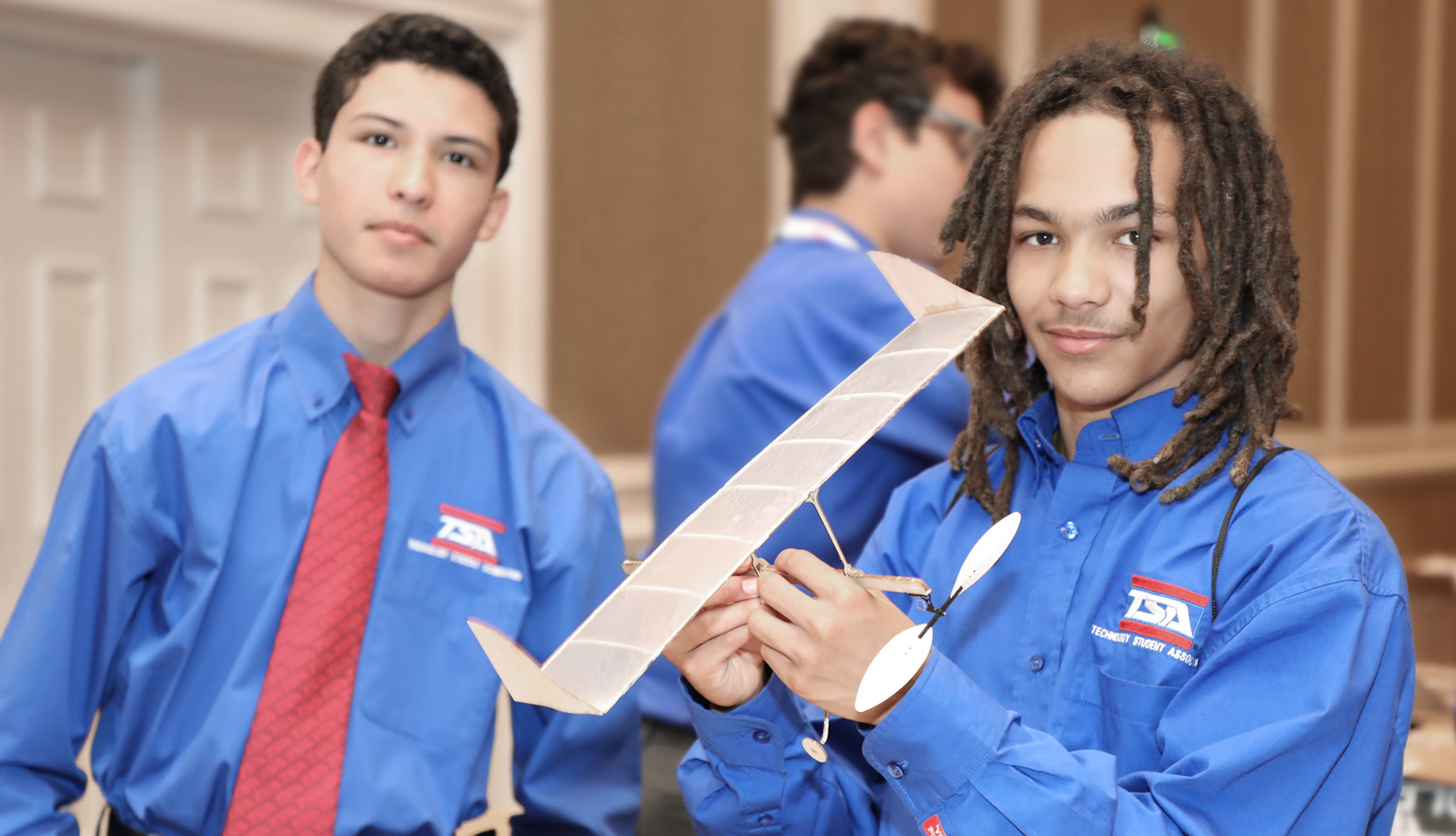
TSA offers 36 middle school competitions. Click on a category below to view a list of TSA middle school competitions and their summary descriptions in that category.
Coding
To qualify for the semifinal round of competition, participants take a test that concentrates on computer science and coding. Semifinalists demonstrate their programming knowledge by developing a solution to an onsite coding challenge.
Community Service Video
Participants create a video that depicts the local TSA chapter’s
involvement in a community service project. Semifinalists deliver a presentation on the project and participate in an interview.
involvement in a community service project. Semifinalists deliver a presentation on the project and participate in an interview.
Computer Aided Design (CAD) Foundations
Participants demonstrate their understanding of CAD fundamentals by creating a two-dimensional (2D) graphic representation of an engineering part or object and answering questions from evaluators about their entry.
Construction Challenge
Participants submit a scale model, display, and documentation portfolio for a design idea and plan for their construction solution based on the annual theme. Semifinalists deliver a presentation about their entry and participate in an interview.
Cybersecurity
Participants take a test that assesses knowledge of cybersecurity vocabulary and the skills needed to execute common cybersecurity tasks. Using digital presentation software, semifinalists deliver a presentation that addresses the annual theme/problem.
Data Science and Analytics
Participants conduct research on the annual topic and analyze the provided data set, document their research in supporting portfolio, and create a display. Semifinalist teams participate in an onsite presentation highlighting their pre-conference submission.
TSA offers 36 middle school competitions. Click on a category below to view a list of TSA middle school competitions and their summary descriptions in that category.
Board Game Design
Participants develop, build, and package a board game that focuses on a subject of their choice. Creative packaging, and the instructions, pieces, and cards associated with the pilot game will be evaluated. Semifinalists set up the game, demonstrate how the game is played, explain the game’s features, and discuss the design process.
Chapter Team
Participants take a parliamentary procedure test to qualify for the semifinal round of competition. Semifinalists conduct an opening ceremony, items of business, parliamentary actions, and a closing ceremony.
Children's Stories
In response to the annual theme, participants create an illustrated children’s story of artistic, instructional, and social value, and submit documentation related to the development of the physical storybook. Semifinalists read their story aloud and participate in an interview.
Computer-Aided Design (CAD), Architecture
Participants use complex computer graphic skills, tools, and processes to respond to a design challenge in which they develop representations of architectural subjects, such as foundation and/or floor plans, and/or elevation drawings, and/or details of architectural ornamentation or cabinetry. The solution to the design challenge and participant answers in an interview are evaluated.
Computer-Aided Design (CAD), Engineering
Participants use complex computer graphic skills, tools, and processes to respond to a design challenge in which they develop three-dimensional representations of engineering subjects, such as a machine part, tool, device, or manufactured product. The solution to the design challenge and participant answers in an interview are evaluated.
Cybersecurity
Applying leadership and 21st century skills, participants respond to a cybersecurity challenge by identifying a breach in computer security via “Capture the Flag” games. Areas of challenge might include exploit development, digital puzzles, cryptography, reverse engineering, binary analysis, mobile security, etc. Participants must accurately address a series of on-site problems within a specified, limited amount of time.